

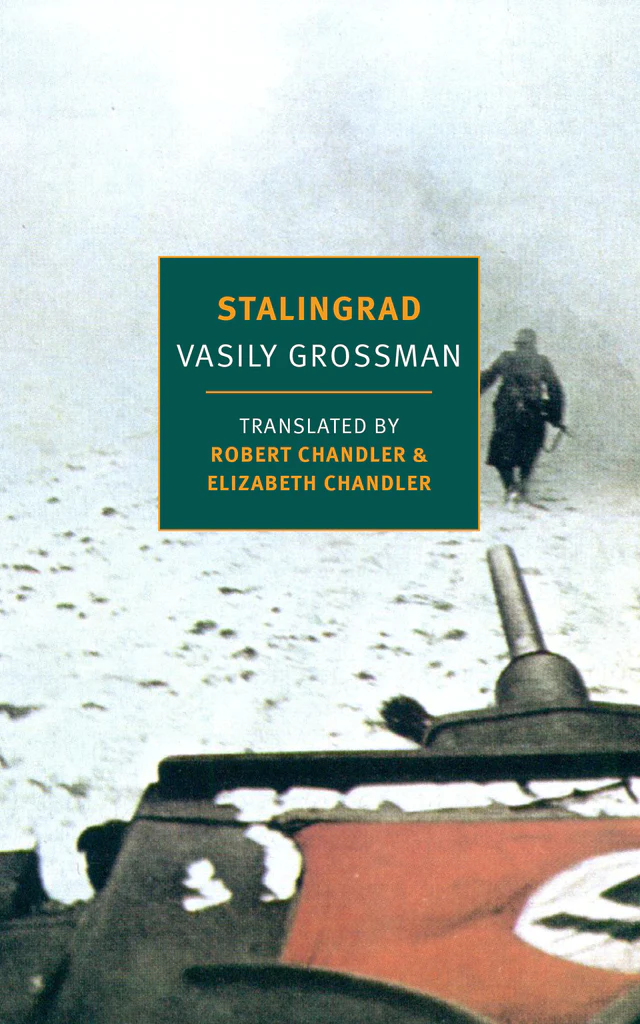
The prequel to Grossman’s most well-known work, Life and Fate, Stalingrad begins in April, 1942, and unfolds across the length and breadth of Russia and Europe. Grossman offers a panoramic view of Soviet society at war. He portrays sections of the technical intelligentsia; miners in Siberia working in war production; children orphaned by the war; historical figures such as Gen. Andrey Yeryomenko, but, above all, Soviet civilians and soldiers, drawn from the working class and peasantry in the city of Stalingrad. Scenes of horrifying violence are followed by scenes that are humorous, poetic, and tender. His depictions of the many who knowingly went to their deaths defending the Soviet Union are outstanding. Grossman has a keen sense of the complexity of human psychology in the face of these enormous historical convulsions and the accompanying mass destruction.
It was the battle of Stalingrad (August 23, 1942 to February 2, 1943), on the western bank of the Volga in the “heart of Russia,” that effectively helped decide the outcome of the war and sealed the fate of the Nazis’ Third Reich. And everyone at the time, from Moscow to Berlin, London, and Washington, understood this. This new (2019) English translation of Stalingrad will not only finally introduce a broad readership to a masterpiece of world literature. It will also help new generations, and especially young people, to understand the enormous impact of the October Revolution and to reconnect with this critical history. Translated by Robert and Elizabeth Chandler.
The World Socialist Web Site has published reviews of the recent editions of Grossman’s monumental novels, as well as an extensive interview with translator Robert Chandler.
Read the WSWS review: The People Immortal
Read the WSWS review: Stalingrad
You might also be interested in the writings of Vadim Rogovin.
