

Vasily Grossman

Life and Fate

$24.95

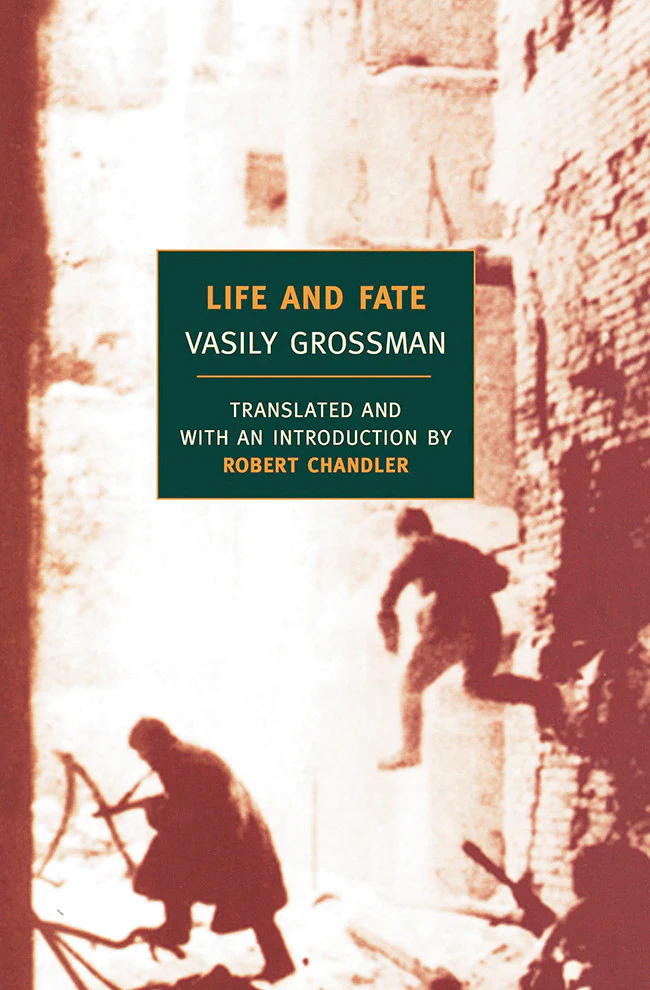
The most well-known of Grossman’s novels, Life and Fate is an epic tale of World War II and a profound reckoning with the dark forces that dominated the twentieth century. Interweaving a transfixing account of the battle of Stalingrad with the story of a single middle-class family, the Shaposhnikovs, scattered by fortune from Germany to Siberia, Vasily Grossman fashions an immense, intricately detailed tapestry depicting a time of almost unimaginable horror for the Soviet people. Life and Fate takes the reader into the hearts and minds of characters ranging from a boy on his way to the gas chambers to Hitler and Stalin themselves. This novel of unsparing realism and visionary moral intensity is one of the supreme achievements of modern Russian literature.

Availability: Only 3 left in stock (can be backordered)

- +

See all publication information ›

Frequently Bought Together

The most well-known of Grossman’s novels, Life and Fate is an epic tale of World War II and a profound reckoning with the dark forces that dominated the twentieth century. Interweaving a transfixing account of the battle of Stalingrad with the story of a single middle-class family, the Shaposhnikovs, scattered by fortune from Germany to Siberia, Vasily Grossman fashions an immense, intricately detailed tapestry depicting a time of almost unimaginable horror for the Soviet people. Life and Fate takes the reader into the hearts and minds of characters ranging from a boy on his way to the gas chambers to Hitler and Stalin themselves. This novel of unsparing realism and visionary moral intensity is one of the supreme achievements of modern Russian literature.

The World Socialist Web Site has published an extensive interview with translator Robert Chandler.

You may also be interested in these reviews from the WSWS: The People Immortal, Stalingrad

You might also be interested in the writings of Vadim Rogovin.


Soviet writer Vasily Grossman was born in 1905, the year of the first Russian Revolution, in Berdichev, a town in what is now Ukraine, which then formed part of the Russian Empire. After the 1917 October Revolution and the civil war Grossman moved to Moscow in 1923, where he studied to become an engineer.

Though never a party member, he witnessed first hand the major political and literary debates and struggles of the 1920s, in which Leon Trotsky’s Left Opposition opposed the nationalist betrayal of the October Revolution by the Soviet bureaucracy.
Grossman survived the Great Terror of 1937-1938, and during World War II he became one of the most popular war correspondents with the Red Army. Grossman was the first journalist to cover the Nazi genocide of Eastern European Jewry.

All of Grossman’s writings during and after the war were subject to significant censorship, including during Nikita Khrushchev’s Thaw (mid-1950s to mid-1960s).

Weight 3 lbs
Dimensions 5.25 × .7 × 8 in
Format

Paperback

Publication Type

Publisher

Author

Shopping Cart