

Franz Mehring (1846 – 1919) was a revolutionary Marxist historian, philosopher, and cultural critic in the German wing of the Second International (Social-Democratic Party-SPD).
An immensely influential figure, Mehring made key contributions to the workers’ movement through his historical analysis, literary criticism and polemics.
He was born in a small Prussian town in an underdeveloped area and received a classical education. His doctoral thesis, “German Social Democracy: History and Lessons” (1877), attacked Karl Marx and the SPD, accusing the party of inciting hatred toward the German “fatherland.” During the 1880s and 1890s, he worked as a journalist and wrote from a bourgeois democratic perspective.
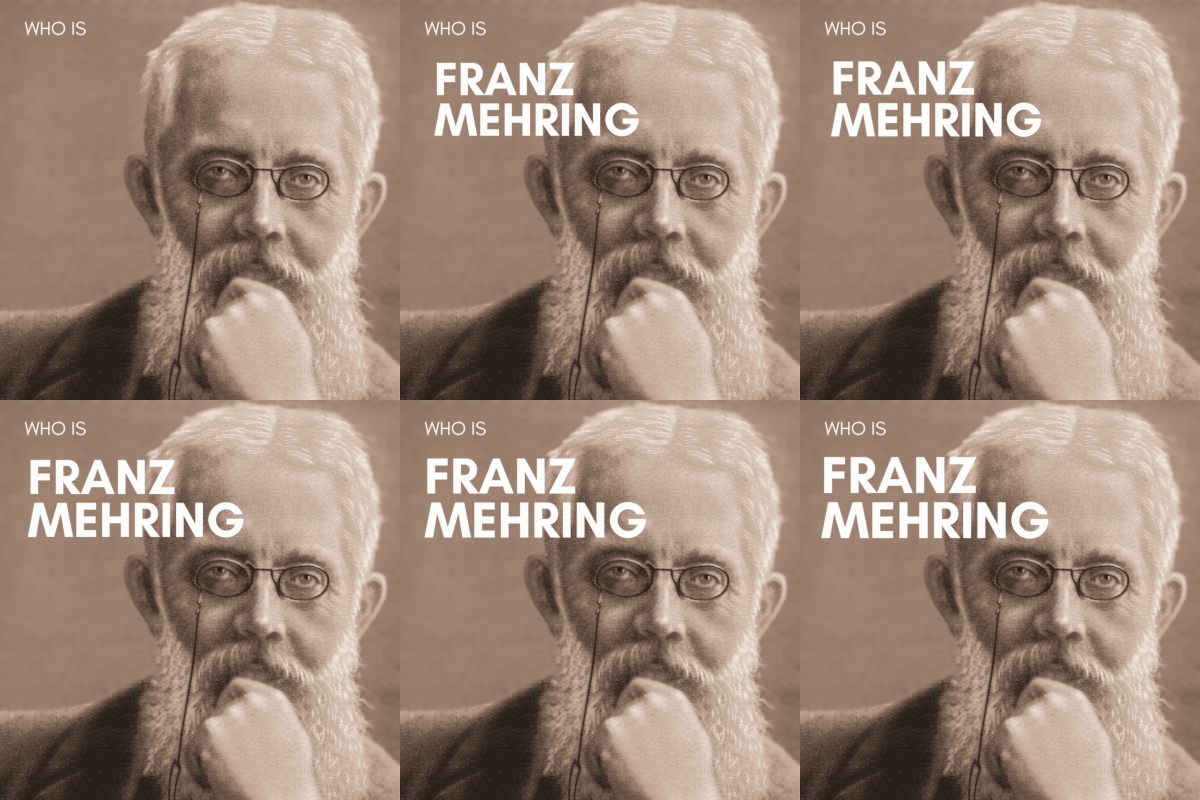
Remarkably however, through his polemics, he came to view Marxism as correct in both its method and conclusions, and in 1891 at the age of 45, he joined the SPD. From that time on, he stood on the left wing of the party, against all those who would betray its program.
Mehring became an indefatigable proponent of Marxism and the revolutionary role of the working class. He supported the Russian Revolutions of 1905 and 1917 and combated the influence of national opportunism in the Second International.
His best-known works include The Lessing Legend; a four-volume history of the German Social Democracy; a history of Germany from the end of the Middle Ages; and the first comprehensive biography of Karl Marx, published in 1918. These brought into the working class the fundamentals of Marxism, the movement’s traditions, Prussian history and classical German literature, all aimed at immunizing workers against the nationalist myths and militarist ideology that prevailed in bourgeois circles.
Mehring wrote for several Social Democratic publications, including Vorwärts and Die Neue Zeit, and served as editor-in-chief of the Leipziger Volkszeitung. His writings often took polemical form on contemporary political, historical, philosophical and cultural issues.
In Die Neue Zeit, Mehring exposed a fraudulent attempt by patriotic cultural figures to portray the Enlightenment philosopher and literary figure Gotthold Lessing as both a product of and a supporter of Prussian absolutist rule. He demonstrated that Lessing had in fact hated the Prussian king and rebelled against the feudal order. Frederick Engels would praise Mehring’s “The Lessing Legend” as “by far the best presentation in existence of the genesis of the Prussian state.”
Mehring also led the Freie Volksbühne (Free People’s Stage) association in Berlin, which provided access to arts and culture that was denied to the poorest workers.
Mehring polemicized against neo-Kantians who sought to divert the SPD from the path of socialist revolution. He also combated attempts to undermine the SPD’s Marxist foundations with idealist and irrationalist conceptions.
He challenged the influence of Friedrich Nietzsche in the workers’ movement, arguing that – his “revolutionary” language notwithstanding – Nietzsche’s philosophy was an ideological expression of the economic ascendancy of the German bourgeoisie. Demonstrating that many of his arguments against socialism were borrowed from German nationalist Heinrich von Treitschke, and emphasizing above all his opposition to the proletarian class struggle, Mehring noted Nietzsche opposed even modest improvements to the condition of the lower classes.
An astute political observer, Mehring immediately recognized the significance of the 1905 Russian Revolution. He wrote, “What distinguishes the great Russian Revolution from the great French Revolution [of 1789] is its leadership by the class-conscious proletariat,” using Marx’s term “revolution in permanence,” more fully developed later by Leon Trotsky.
Defending the Russian revolutionaries of 1905 against accusations of reckless adventurism, he argued that Marx would have supported their efforts to build a socialist society, even in a country that was not yet industrialized. Stressing the international significance of the Russian Revolution, he told the German workers: “The cause of your Russian brothers is also yours.”
He collaborated with Rosa Luxemburg in publishing Die Internationale, which opposed World War I from a revolutionary internationalist perspective. He understood that the war was not an accident, but an essential feature of the crisis of the capitalist world order that required a world socialist revolution as a response.
“For decades now you have occupied a special post in our movement, and no one else could have filled it. You are the representative of real culture in all its brilliance. If the German proletariat is the historic heir of classic German philosophy, as Marx and Engels declared, then you are the executor of that testament. You have saved everything of value which still remained of the once splendid culture of the bourgeoisie and brought it to us, into the camp of the socially disinherited. Thanks to your books and articles the German proletariat has been brought into close touch not only with classic German philosophy, but also with classic German literature, not only with Kant and Hegel, but with Lessing, Schiller and Goethe. Every line from your brilliant pen has taught our workers that socialism is not a bread and butter problem, but a cultural movement, a great and proud world-ideology.” – Rosa Luxemburg letter to Franz Mehring on his 70th birthday, February 27, 1916.
Mehring’s opposition to World War I led him to join the Spartacus League, along with Rosa Luxemburg, Karl Liebknecht and Clara Zetkin. In August 1916, the German government jailed him for four months, further damaging his health.
Mehring enthusiastically supported the October 1917 Russian Revolution, vigorously defending the Bolsheviks against Karl Kautsky. Although now aged and ill, he was closely involved in the preparations for the founding congress of the German Communist Party on January 1, 1919.
Mehring died on January 28, 1919, just two weeks after his comrades-in-arms – Rosa Luxemburg and Karl Liebknecht – were murdered by the right-wing extremist Freikorps, with the approval of the SPD government.
Read more about Franz Mehring on the World Socialist Web Site.
