

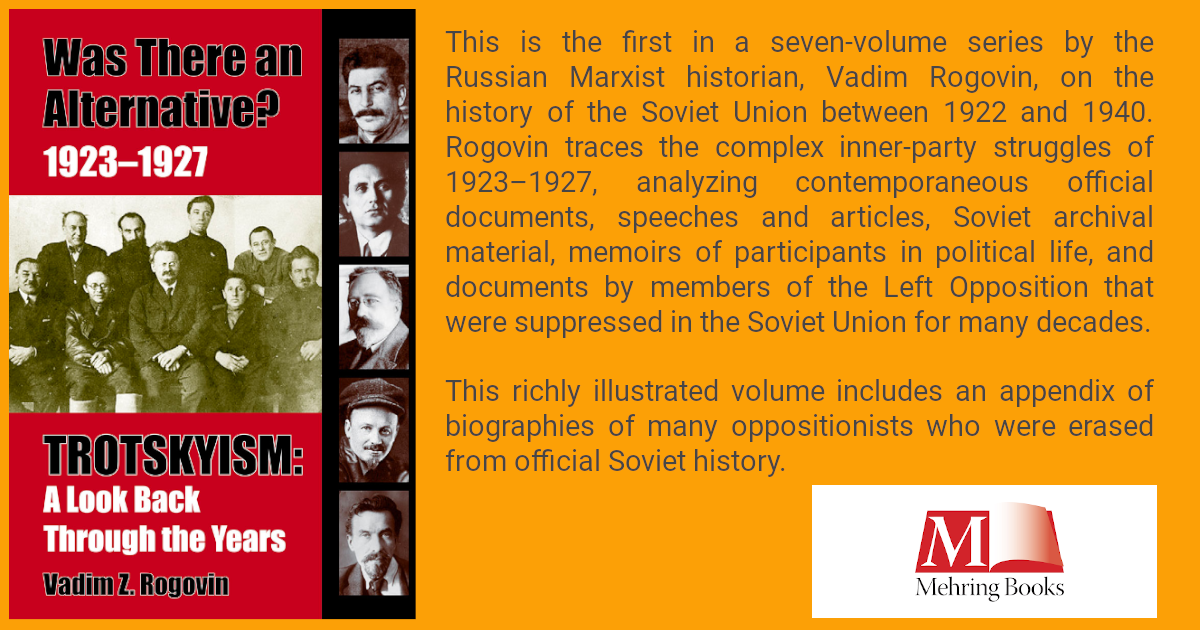

VADIM Z ROGOVIN
Was There an Alternative? 1923–1927. Trotskyism: A Look Back Through the Years
New release! Pre-order now with your 25% off coupon
This is the first in a seven-volume series by the Russian Marxist historian, Vadim Rogovin, on the history of the Soviet Union between 1922 and 1940. Rogovin traces the complex inner-party struggles of 1923–1927, analyzing contemporaneous official documents, speeches and articles, Soviet archival material, memoirs of participants in political life, and documents by members of the Left Opposition that were suppressed in the Soviet Union for many decades.
This richly illustrated volume includes an appendix of biographies of many oppositionists who were erased from official Soviet history.
Mehring offers three more volumes from the series

Bolsheviks Against Stalinism 1928–1933; Leon Trotsky and the Left Opposition
Rogovin traces the inner-party struggles of 1928-1933, utilizing official documents; speeches and articles of the time; Soviet archival material; memoirs of participants in contemporary political life; and documents by oppositionists in various groups that were unknown to Soviet readers for many decades.

1937: Stalin’s Year of Terror
A major work of original historical research, 1937 provides a detailed and penetrating analysis of the causes and consequences of Stalin’s purges.
The author, an eminent Russian Marxist historian, argues that it is impossible to understand these tragic events apart from Stalin’s determination to wipe out all vestiges of the socialist opposition to his regime, above all, that associated with Leon Trotsky.

Stalin’s Terror of 1937-1938: Political Genocide in the USSR
This volume examines the bloodiest period of the Stalinist repression of political opposition in the Soviet Union, debunking the myth that the Great Purges were merely the product of Stalin’s paranoia and had no overriding political logic.

Vadim Z. Rogovin
Vadim Rogovin (1937-1998) was a Doctor of Philosophical Sciences at the Institute of Sociology of the Russian Academy of Sciences in Moscow from the late 1970s until his death. Prior to this he had worked in the field of literary and aesthetic criticism.
Rogovin died at the age of 61, after completing six volumes of a seven-volume history of the political conflicts within the Communist Party of the USSR and the Communist International between 1922 and 1940. The seventh volume was published posthumously.

2017 Centenary Lectures
Why Study the Russian Revolution?
The Russian Revolution of 1917 ranks among the most significant events in world history. One hundred years after the coming to power of the Bolshevik Party, the bitter controversy that still surrounds discussion of the revolution testifies to its enduring impact and relevance.
