

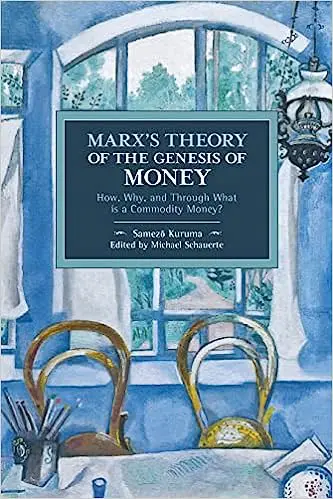

In this volume, Japanese Marxist economist Samezo Kuruma (1893-1982) performs a meticulous explication of the first two chapters of Marx’s Capital. These chapters—setting forth Marx’s theory of the commodity, his labor-theory of value, and the theories of commodity fetishism and the exchange process—are generally acknowledged to challenge the reader who is new to Marx, and Kuruma’s methodical and jargon-free presentation provides a most welcome companion.
Marx’s Theory of the Genesis of Money gathers revised translations of four articles originally published in the journal Kezai shirin as a series titled “Theory of the Value Form and Theory of the Exchange Process,” the first three articles in 1950-51 and the fourth in 1979. Included in this work are Kuruma’s polemical responses to interpretations of Marx by influential Japanese economists Kozo Uno and Nobuteru Takeda. By attending painstakingly to what Marx actually wrote, Kuruma achieves a deeply persuasive reading with which more students of Marx should be familiar.
Contents
Acknowledgements
Notes on the Text
Introduction to This Edition
Part 1
Theory of the Value Form and Theory of the Exchange Process
Preface
1 Theory of the Value Form and Theory of the Exchange Process
2 Why is the Want of the Commodity Owner Abstracted from in the Theory of the Value Form?
(A Response to the View of Kozo Uno)
Uno’s First Argument
Uno’s Second Argument
Uno’s Third Argument
Part 2
Marx’s Theory of the Genesis of Money (An Interview Conducted by Teinosuki Otani)
1 The Questions ‘How, Why, and Through What’
(The Genesis of Money)
2 Riddle of the Money Form and the Riddle of Money
3 Difference Between the First and Second Edition of Capital
4 The Significance of the ‘Why Question’
(The Particularity of Commodity Production and the Essence of Value)
5 In What Sense Is the Simple Value Form ‘Accidental’?
6 The ‘Detour’ of Value Expression
7 The Meaning of the ‘Formal Content of the Relative Expression of Value’
(Hegel’s Theory of Judgment and Marx’s Theory of the Value Form)
8 How the Development of the Value Form Unfolds
(Neither a Historical Development, Nor the ‘Self-Development of a Concept’)
9 The Meaning of Abstracting from the Individual Want of the Commodity Owner
(Nobuteru Takeda’s Criticism of Kuruma)
10 What is the ‘Dialectic’ in the Case of the Value Form?
Bibliography
Index
